Mastering Emotional Regulation: 5 Insider Strategies 2026
Advertisements
529 College Savings Plan Rollover Rules now allow eligible unused education savings to move into a Roth IRA without the usual penalty.
The provision creates more flexibility for families whose beneficiaries no longer need the full balance for qualified education expenses.
Understanding the $35,000 lifetime cap, annual limits, and eligibility requirements is essential before starting a rollover.
Understanding the New 529 to Roth IRA Rollover Provisions
New rollover provisions allow certain unused 529 funds to be transferred into a Roth IRA for the plan beneficiary.
The change provides an alternative to withdrawing unused funds and potentially facing taxes or penalties on nonqualified distributions.
These 529 College Savings Plan Rollover Rules can therefore add flexibility to long-term education and retirement planning.
Eligibility Criteria for the 529 to Roth IRA Conversion
The 529 account must generally have been open for at least 15 years before eligible funds can be rolled into a Roth IRA.
The receiving Roth IRA must belong to the 529 beneficiary, ensuring the money continues to benefit the original student.
Contributions made during the previous five years, along with related earnings, are excluded from the eligible rollover amount.
Key Requirements for a Smooth Transition
Eligibility depends on meeting the account-age requirement and confirming that the Roth IRA belongs to the correct beneficiary.
The 529 account must have been established for a minimum of 15 years.
The Roth IRA must be owned by the beneficiary of the 529 plan.
Contributions made within the last five years are ineligible for rollover.
Recent contributions must also be separated from older eligible funds before determining how much can actually be transferred.
Following these rules carefully is essential when using the 529 College Savings Plan Rollover Rules without triggering avoidable problems.
The $35,000 Rollover Limit and Annual Caps
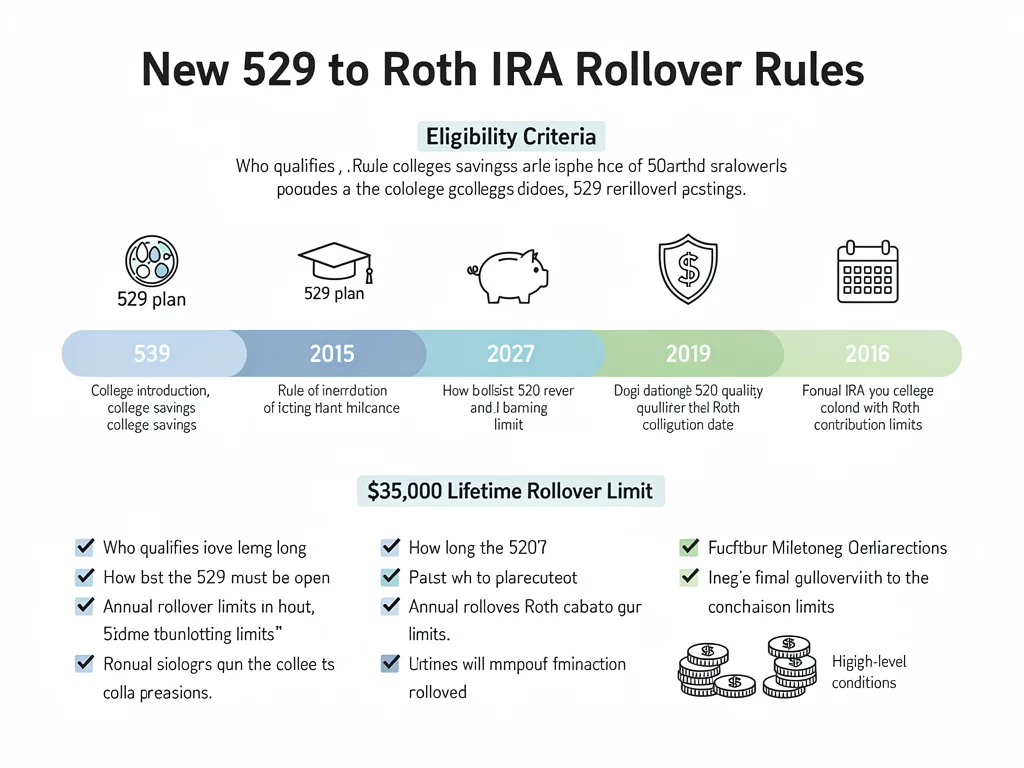
The total lifetime amount that can be moved from an eligible 529 plan into a Roth IRA is capped at $35,000.
That amount cannot necessarily be transferred at once because each rollover is also subject to annual Roth IRA contribution limits.
Using the 529 College Savings Plan Rollover Rules may therefore require transfers across multiple years.
Navigating Annual Contribution Limits
Beneficiaries must compare the intended rollover with the Roth IRA contribution limit that applies during each calendar year.
Amounts rolled from the 529 count toward that annual limit, reducing room for separate Roth IRA contributions in the same year.
Careful tracking helps prevent excess contributions while gradually using the available $35,000 lifetime rollover allowance.
Strategic Benefits of the 529 to Roth IRA Rollover
The rollover option gives families another use for excess 529 savings when the beneficiary does not need the full education balance.
Eligible funds moved into a Roth IRA can continue growing for retirement under the rules that apply to Roth accounts.
This added flexibility makes the 529 College Savings Plan Rollover Rules useful for broader financial planning.
Long-Term Financial Planning Advantages
The provision can reduce concern about leaving too much money in a 529 plan after education expenses have already been covered.
Avoids potential penalties on unused 529 funds.
Provides tax-free growth and withdrawals in retirement via Roth IRA.
Offers flexibility for changing education or career paths.
It also creates a potential bridge between education savings and retirement savings for the same beneficiary.
This flexibility may encourage families to view 529 accounts as more adaptable tools within a long-term financial strategy.
Impact on Education and Retirement Savings Strategies
The new 529 College Savings Plan Rollover Rules connect education savings with future retirement planning.
Parents and grandparents may feel more comfortable contributing when unused qualified funds have another possible long-term destination.
This connection can make education and retirement planning more integrated, especially when beneficiaries finish school with money remaining.
Evolving Financial Advice
Financial planning now needs to consider the 15-year account requirement when evaluating future rollover possibilities.
Opening a 529 earlier may become more relevant because the account must meet that age requirement before qualifying.
The 529-to-Roth option therefore adds another factor for advisors and families when developing long-term savings strategies.
Considerations Before Initiating a Rollover
Before transferring funds, families should first determine whether the beneficiary may still need the money for qualified education expenses.
Eligibility, tax treatment, account history, and available annual Roth IRA contribution space should also be reviewed carefully.
Professional guidance may be helpful when applying the 529 College Savings Plan Rollover Rules to an individual financial situation.

Potential Pitfalls and Best Practices
Moving funds too early could reduce money that may still be needed for education, so future expenses should be reviewed first.
Ensure the beneficiary has exhausted all reasonable qualified education expenses.
Verify the 529 account has been open for at least 15 years.
Confirm no contributions have been made in the last five years to the amount being rolled over.
Account history should also be checked carefully to separate eligible balances from contributions made during the restricted five-year period.
Confirming all requirements before beginning the transfer can reduce delays and unintended tax consequences during the rollover process.
The Role of SECURE Act 2.0 in Expanding Financial Flexibility
The 529 College Savings Plan Rollover Rules were introduced through SECURE Act 2.0.
The legislation expanded several retirement-related provisions and created a way to redirect qualifying unused education savings into retirement funds.
This change reflects a broader effort to provide savers with more flexibility as education, employment, and retirement plans evolve.
Broader Implications of SECURE Act 2.0
SECURE Act 2.0 also included changes involving required minimum distributions, catch-up contributions, and retirement plan enrollment.
Together, these provisions aim to improve access to retirement savings and give individuals more options across different life stages.
The 529-to-Roth provision is one part of that broader framework, linking two traditionally separate savings goals.
Future Outlook: What to Expect from 529 Plan Rollovers
The long-term effects of the 529 College Savings Plan Rollover Rules will become clearer as more beneficiaries use the provision.
Future policy adjustments could potentially refine limits, eligibility rules, or administrative processes based on how the system performs.
Financial institutions may also improve their procedures as rollover activity becomes more common and account holders gain experience.
Anticipating Further Refinements
Account holders should continue monitoring legislative and regulatory updates that could affect rollover limits or eligibility requirements.
Monitoring legislative updates for potential changes to rollover limits or rules.
Observing how financial institutions streamline the rollover process.
Assessing the overall impact on both education and retirement savings trends.
Changes in financial institution procedures may also make future transfers easier to understand and complete.
Ongoing attention to new guidance can help families use this option more effectively as the rollover framework continues to develop.
Key Point | Brief Description |
|---|---|
Rollover Limit | Up to $35,000 lifetime maximum can be converted to a Roth IRA. |
Eligibility | 529 plan open for 15+ years; Roth IRA in beneficiary's name. |
Annual Cap | Subject to annual Roth IRA contribution limits. |
Strategic Benefit | Avoids penalties on unused 529 funds, converts to tax-free retirement growth. |
Frequently Asked Questions About 529 to Roth IRA Rollovers
What is the primary benefit of the new 529 to Roth IRA rollover rule?▼
It allows eligible unused 529 funds to move into a Roth IRA without the usual penalty, creating another long-term use for the money.
Are there any age restrictions for the beneficiary to perform the rollover?▼
The source does not specify a beneficiary age restriction, but the 529 must have been open at least 15 years and other requirements apply.
Can I roll over funds if I recently contributed to my 529 plan?▼
Contributions made within the previous five years, along with their earnings, are not eligible for the Roth IRA rollover.
Does the $35,000 rollover limit apply annually or over a lifetime?▼
The $35,000 amount is a lifetime maximum, while each yearly transfer remains subject to the annual Roth IRA contribution limit.
What steps should I take before initiating a 529 to Roth IRA rollover?▼
Confirm eligibility, review future education needs, check account history, and consider professional guidance before beginning the transfer.
What This Means for Your Financial Future
The 529 College Savings Plan Rollover Rules provide a new way to repurpose eligible unused education savings.
The option can reduce concerns about overfunding college accounts while giving beneficiaries another potential source of long-term retirement savings.
Careful planning remains essential because lifetime limits, annual caps, account-age rules, and recent contributions all affect rollover eligibility.