Mastering Emotional Agility: Rewire Self-Talk for Consistency
Advertisements

The emotional agility framework offers a practical way to relate more flexibly to difficult thoughts, emotions, and everyday choices.
Rather than trying to eliminate uncomfortable feelings, the approach encourages people to notice them, create perspective, reconnect with personal values, and choose actions intentionally.
These four steps can support more thoughtful self-talk and habit formation, although there is no established evidence that they increase habit consistency by a fixed percentage such as 40%.
Understanding the Core of Emotional Agility
Emotional agility describes the ability to remain open to thoughts and emotions while continuing to act in ways that reflect personal values.
The goal is not to suppress unpleasant feelings or force positive thinking, but to relate to internal experiences with greater curiosity and flexibility.
Susan David's framework presents emotional agility as an ongoing process rather than a one-time technique or quick solution.
The Shift from Suppression to Engagement
Trying to avoid or suppress difficult emotions can sometimes make people more preoccupied with the very experiences they are trying not to feel.
Emotional agility instead emphasizes recognizing thoughts and feelings without treating them as commands that must determine behavior.
This creates space between an internal reaction and the action that follows, allowing values and context to play a larger role.
Notice thoughts and emotions without immediately judging them.
Identify what the emotion may be signaling.
Create psychological distance from automatic narratives.
Choose actions based on values rather than impulse alone.
The 4-Step Emotional Agility Framework
The four-step framework consists of Showing Up, Stepping Out, Walking Your Why, and Moving On.
These steps are not a newly developed 2026 intervention; they have been part of Susan David's Emotional Agility model for years.
Used together, they provide a structure for becoming more aware of internal experiences while responding with greater flexibility.
Step 1: Showing Up — Acknowledging Thoughts and Emotions
Showing Up means allowing thoughts and emotions to be noticed rather than automatically avoiding, suppressing, or fighting them.
The emphasis is on approaching internal experiences with curiosity and compassion instead of immediately categorizing them as good or bad.
This awareness can make it easier to recognize patterns in self-talk before those patterns automatically drive behavior.

Step 2: Stepping Out — Creating Distance from Your Inner Narrative
Stepping Out involves recognizing that having a thought does not make that thought an objective fact.
A person might shift from “I always fail” to “I'm noticing the thought that I always fail,” creating a small but meaningful amount of psychological distance.
The aim is not to erase the thought, but to see it more clearly and reduce the likelihood of responding to it automatically.
Notice thoughts as mental events rather than absolute truths.
Name recurring stories or patterns when they appear.
Create space before reacting to emotionally charged thoughts.
Return attention to the action that is most useful in the moment.
Emotional Agility and Daily Self-Talk
Self-talk can influence how people interpret setbacks, evaluate progress, and decide whether to continue a difficult behavior.
Emotional agility does not require replacing every negative thought with a positive one.
Instead, it encourages a more flexible relationship with internal language so that thoughts provide information without automatically controlling behavior.
Moving Beyond Forced Positive Thinking
Statements such as “everything is fine” may be unhelpful when someone genuinely feels disappointed, anxious, or frustrated.
A more flexible response might acknowledge the difficulty while also identifying what remains within the person's control.
This approach preserves emotional honesty while creating room for constructive action.
Cultivating Self-Compassion and Resilience
Self-compassion can support emotional flexibility by reducing the tendency to turn setbacks into harsh judgments about personal worth.
Resilience is also relevant because habits and personal goals rarely progress without interruptions or setbacks.
Together, these qualities can make it easier to respond to difficulty with adjustment rather than abandonment or self-punishment.
The Role of Mindful Self-Talk in Habit Formation
Habit consistency often depends on what happens after a missed day, failed attempt, or unexpected disruption.
Self-critical thinking can turn one setback into a broader conclusion such as “I have no discipline,” which may make returning to the behavior more difficult.
A more flexible response focuses on what happened, what can be learned, and what small action can be taken next.
Integrating Values and Purpose for Lasting Change
Values play a central role in the Emotional Agility framework because they help determine which actions are worth taking even when those actions feel uncomfortable.
Values are not the same as goals; a goal can be completed, while a value describes an ongoing direction such as curiosity, health, connection, or responsibility.
Linking habits to values can provide a clearer reason for continuing them when short-term motivation fluctuates.
Step 3: Walking Your Why — Aligning Actions with Values
Walking Your Why means using personal values as a guide when deciding what to do next.
The question shifts from “What do I feel like doing?” to “What action would move me toward what matters to me?”
This does not eliminate discomfort, but it can help people act meaningfully even when motivation or confidence is imperfect.
Identify a small number of values that genuinely matter to you.
Connect daily habits to those broader values.
Choose small actions that move in the desired direction.
Review whether routines still reflect what matters most.
Step 4: Moving On — Adapting with Flexibility
Moving On involves adjusting behavior as circumstances change instead of rigidly following a plan that no longer works.
This can mean making a habit smaller, changing its timing, modifying the environment, or reconsidering whether the goal still serves an important value.
Flexibility allows people to preserve direction without demanding perfect execution.
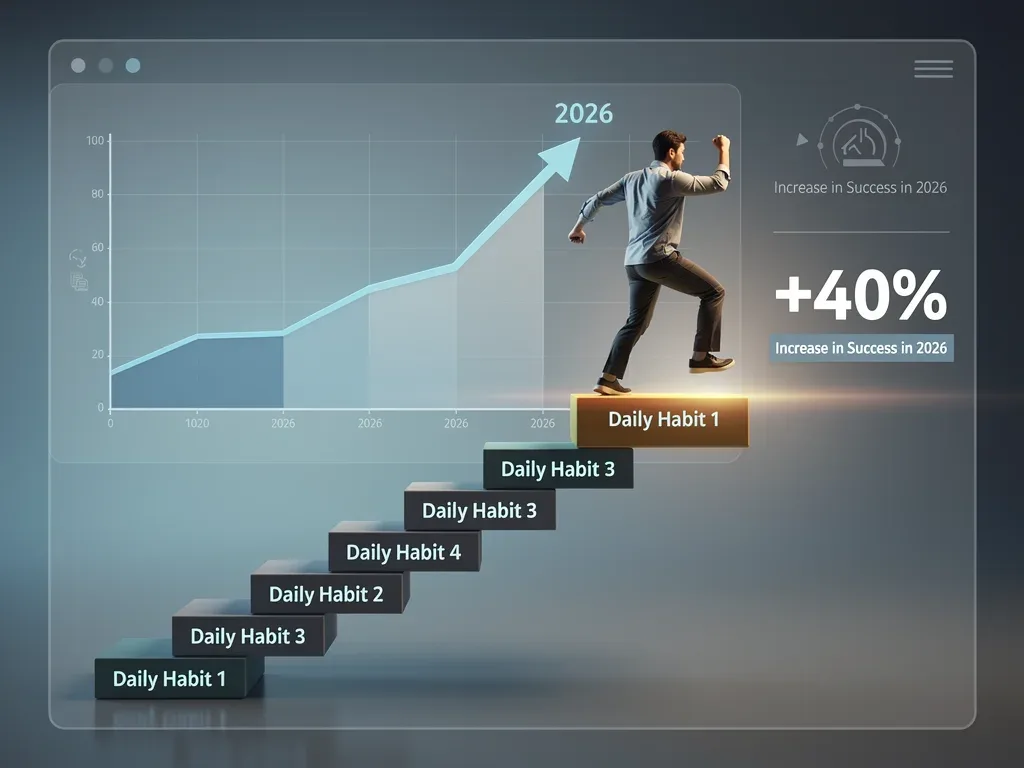
How Emotional Agility Can Support Habit Consistency
Emotional agility may help with habits by addressing moments when frustration, boredom, anxiety, or self-doubt interfere with intended behavior.
Instead of requiring a person to feel motivated first, the framework emphasizes noticing internal resistance and then choosing an action aligned with values.
This provides a plausible pathway for more consistent behavior, but current evidence does not justify promising a specific percentage improvement.
Use Smaller Value-Aligned Actions
When a habit feels difficult, reducing the size of the action can make returning to it more realistic.
A person who cannot complete a full workout, for example, might still choose a short walk if physical health remains an important value.
The purpose is to maintain connection with the desired direction rather than interpret anything short of the ideal routine as failure.
What the Evidence Can and Cannot Tell Us
The four-step Emotional Agility framework is well established in Susan David's published work and educational materials.
However, that does not mean every specific claim about habit adherence, productivity, relationships, or mental health has been validated by controlled research.
Evidence-based psychological claims require appropriate research designs, meaningful outcomes, and replication rather than projections or anecdotal success stories alone.
No Verified 40% Habit-Consistency Effect
There is no well-supported evidence establishing that Emotional Agility increases habit consistency by exactly 40%.
Likewise, there is no verified basis for presenting that number as a research projection specifically for 2026.
The more accurate approach is to describe the framework as a practical model that may support flexible, values-based behavior without guaranteeing a numerical outcome.
Why Unsupported Precision Can Be Misleading
A precise claim such as “40% more consistent” implies that a defined intervention was tested against a comparison group using a clearly measured outcome.
Without published methodology, sample size, statistical analysis, and replication, such a percentage should not be treated as established evidence.
Removing unsupported precision makes the article more credible without weakening the practical usefulness of the framework.
Be Careful With Pilot-Program Claims
The original claim that a 50-person pilot produced a 35% improvement in meditation consistency could not be verified from a credible published source.
Small pilot studies can also be useful for generating hypotheses without establishing that the same result will occur in a broader population.
Claims about effectiveness should therefore distinguish between published evidence, preliminary findings, personal reports, and illustrative examples.
Using Emotional Agility in Everyday Situations
The framework can be applied when difficult emotions create tension between short-term comfort and longer-term priorities.
A person might notice anxiety before an important conversation, step back from catastrophic thoughts, remember the value of honesty, and then choose to speak respectfully.
The same sequence can be applied to studying, exercise, work routines, relationships, and other everyday decisions.
A Simple Daily Example
Imagine that you planned to exercise after work but arrive home feeling exhausted and discouraged.
You might acknowledge the exhaustion, notice the thought “there's no point unless I do the entire workout,” and reconnect with the value of taking care of your health.
You could then choose a shorter activity while preserving the habit without demanding perfection.
Emotional Agility Is Not Emotional Suppression
Emotional agility does not ask people to ignore, control, or quickly eliminate uncomfortable emotions.
The framework instead treats emotions as experiences that can contain useful information without necessarily dictating the next action.
This distinction is important because emotional flexibility differs from simply forcing oneself to feel positive.
Emotions as Data, Not Directives
An emotion such as fear may communicate that something feels uncertain or important.
That information deserves attention, but fear alone does not determine whether a person should proceed, stop, seek support, or gather more information.
Emotional agility creates room to consider both the feeling and the broader context before acting.
When Self-Help Is Not Enough
Emotional Agility is a personal-development framework and should not be presented as a substitute for professional mental health treatment.
Persistent anxiety, depression, trauma symptoms, severe emotional distress, or major impairment may require assessment and support from a qualified professional.
Self-reflection tools can complement appropriate care, but they should not be used to diagnose or treat mental health conditions independently.
Know the Limits of a General Framework
People differ in personal history, culture, circumstances, stress levels, and mental health needs.
A strategy that feels useful for one person may be insufficient or inappropriate for another.
Evidence-based psychological care combines research evidence with professional expertise and the characteristics and preferences of the individual.
Building a Sustainable Practice
Emotional agility is better approached as an ongoing skill than as a short challenge designed to produce a dramatic transformation.
Small moments of noticing, distancing, choosing, and adapting can gradually become part of daily decision-making.
The focus is consistency of practice and flexibility rather than achieving permanent emotional control.
Start With One Daily Choice
Choose one recurring situation in which emotions frequently influence behavior, such as procrastination, conflict, exercise, or work pressure.
Practice applying the four steps in that situation rather than attempting to transform every area of life at once.
Once the process feels more familiar, it can be applied to additional situations.
Challenges and Considerations
Developing emotional flexibility can be difficult because familiar reactions often occur quickly and automatically.
Changing these patterns requires repeated awareness rather than a single insight or motivational breakthrough.
Setbacks should therefore be expected as part of learning rather than interpreted as evidence that the framework has failed.
Overcoming Resistance to Change
Resistance can appear as avoidance, procrastination, perfectionism, or a strong desire to return to familiar patterns.
Instead of treating resistance as an enemy, emotional agility encourages noticing it and asking what it may reveal about fear, expectations, or competing values.
A smaller, more realistic next step can often preserve momentum without requiring the resistance to disappear first.
Key Framework Step | Brief Description |
|---|---|
Showing Up | Notice thoughts and emotions with curiosity instead of immediately avoiding them. |
Stepping Out | Create distance from thoughts so they are not automatically treated as facts or commands. |
Walking Your Why | Use personal values as a compass for choosing meaningful actions. |
Moving On | Adapt habits and behavior flexibly as circumstances and needs change. |
Frequently Asked Questions about Emotional Agility
What is the main purpose of the four-step Emotional Agility framework? ▼
It helps people relate more flexibly to thoughts and emotions and choose actions that are more consistent with their values.
Is the four-step framework new in 2026? ▼
No. Susan David has described Showing Up, Stepping Out, Walking Your Why, and Moving On for many years, including materials published in 2016.
Does Emotional Agility increase habit consistency by 40%? ▼
There is no credible published evidence supporting a universal 40% increase, so that figure should not be treated as an established outcome.
Does Emotional Agility mean replacing negative thoughts with positive thoughts? ▼
No. The framework emphasizes acknowledging internal experiences and changing how you relate to them rather than forcing positive thinking.
Can the framework support habit formation? ▼
It may help people respond more flexibly to discomfort and setbacks, but habit outcomes depend on many factors and cannot be guaranteed.
Is Emotional Agility a form of mental health treatment? ▼
It is a personal-development framework and should not replace professional assessment or treatment when significant mental health concerns are present.
Looking Ahead: Emotional Agility in 2026
The continued interest in emotional agility reflects a broader emphasis on flexibility, values, self-awareness, and healthier responses to difficult emotions.
The emotional intelligence conversation can benefit from these ideas, but numerical claims about relationships, habits, or productivity should be supported by direct evidence.
In 2026, the most credible way to use the four-step framework is as a practical guide for reflection and values-based action rather than as a newly proven protocol with guaranteed performance gains.
Focus on Practice Rather Than Predictions
Emotional agility is described by its creator as an ongoing process rather than a destination that can be permanently completed.
Its usefulness lies in repeatedly noticing internal experiences, gaining perspective, reconnecting with values, and adapting behavior.
That realistic framing preserves the value of the approach without making promises that current evidence cannot support.